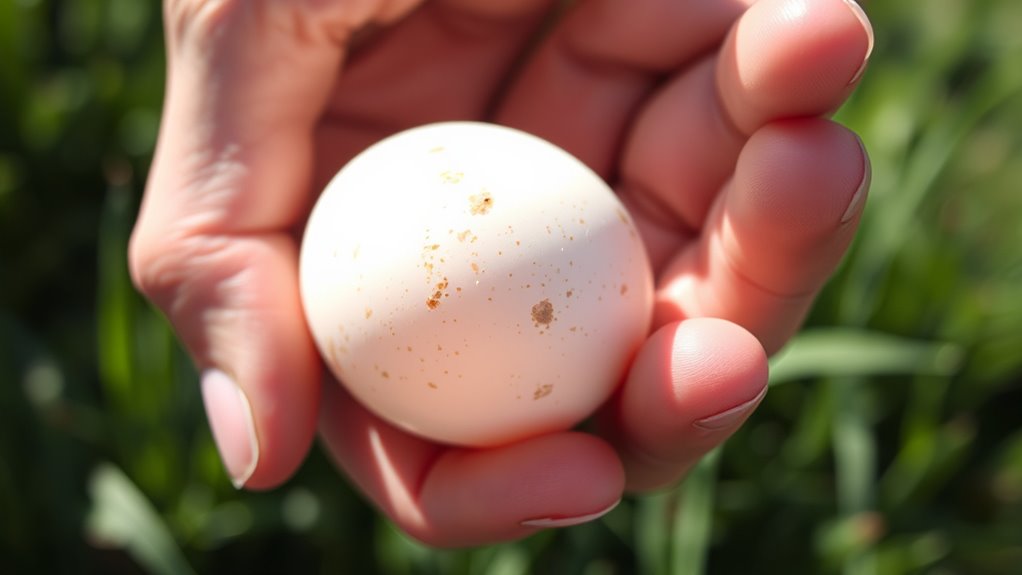
How to Tell If a Chicken Egg Is Fertile
You can tell if a chicken egg is fertile by candling it in a dark room around day 7 to 10 of incubation. This method involves holding a bright light against the shell to look for specific signs of development.
Key indicators include a white bullseye on the yolk and spider-like veins spreading out from a dark embryo spot.
Eggs without these signs are usually unfertilized and will not develop into chicks. Remember, hens lay eggs with or without roosters, but only mated eggs show these features.
Keep exploring to understand more about how fertility affects hatching success and improve your poultry-raising skills.
How Roosters Fertilize Eggs: The Mating Process
Although it might seem quick, the rooster fertilizes eggs through a precise mating process called cloacal contact. When the rooster mounts the hen, their cloacas press together in what’s often called a “cloacal kiss.” This contact transfers sperm directly from the rooster to the hen.
You’ll want to know that the sperm doesn’t just fertilize one egg immediately; it’s stored in the hen’s sperm storage tubules. This allows the hen to lay multiple fertile eggs over several days or even weeks after just one mating. Fertilization happens when the stored sperm meets the ovum in the hen’s oviduct shortly after mating.
Can Hens Lay Eggs Without a Rooster?

You can expect hens to lay eggs even without a rooster around. These eggs, however, are typically unfertilized because fertilization only happens when a hen mates with a rooster. If you want a fertile egg that can develop into a chick, a rooster must be present.
Hens’ egg production depends mainly on their hormonal cycles and environmental factors, not on the presence of a rooster. So, even if there’s no rooster, your hens will continue laying eggs regularly, but these eggs won’t hatch unless fertilized.
In short, hens don’t need a rooster to lay eggs, but if you’re hoping for fertile eggs, you’ll need to introduce a rooster to the flock.
Visual Signs of a Fertile Egg

When you examine a fertile egg carefully, you’ll notice a distinctive white ring called a bullseye on the yolk, which marks early cell development. This bullseye appears as a clear, circular area with a darker center, signaling fertilization.
If you look closer as incubation progresses, you might spot spider-like veins spreading from the center, indicating the growing embryo’s circulatory system. These veins become more visible around day 10. Eggs without this bullseye or clear ring usually contain only yolk and are unfertilized.
Additionally, a transparent, donut-shaped area in the blastoderm can suggest the egg is fertile and starting embryonic development. Recognizing these visual signs helps you confidently distinguish fertile eggs from unfertilized ones.
How to Use Candling to Check Egg Fertility
To check if your chicken egg is fertile, you’ll need to use candling by shining a bright light through it in a dark room. Hold the egg steady and look for signs like a network of veins or a dark spot, which indicate fertility.
Understanding these visual cues will help you interpret the results accurately.
Candling Techniques Explained
Although candling might seem tricky at first, it’s a straightforward way to check egg fertility by shining a bright light through the shell in a dark room. To start, hold the egg at a slight angle and use a strong, focused bright light so you can clearly see inside.
Fertilized eggs around 10 days into incubation will reveal visible blood vessels and a dark embryo spot. Unfertilized eggs, on the other hand, appear mostly clear or show only the yolk without veins or embryo signs.
You can repeat candling throughout incubation to monitor embryo growth and spot any issues early. Mastering these techniques helps you confidently identify fertilized eggs and track their development effectively.
Interpreting Candling Results
Since candling reveals the egg’s internal features, you can interpret these signs to determine fertility confidently. When you candle an egg around day 4, look for a small, round, opaque spot called the germinal disc, which suggests potential fertilization.
By day 10, fertile eggs will show a distinct, dark spider-like network of veins and a developing embryo. Unfertilized eggs, on the other hand, appear clear or translucent, lacking veins or embryo growth.
To get the best candling results, make sure you use a strong, focused light in a dark room. This will help you clearly see the egg’s internal structures and accurately judge whether your egg is fertile or not.
Confirming Fertilization During Incubation
When you candle eggs around day 10 of incubation, you can clearly see dark veins and an embryo that confirm fertilization. Fertile eggs show a distinctive network of spider-like blood vessels and a dark spot called the prime body, signaling healthy development.
In contrast, unfertilized eggs remain mostly clear or only reveal the yolk without any embryonic signs. Between days 7 and 10, these early developmental features become more visible, making this period ideal for confirming fertilization.
Why Fertile-Looking Eggs Don’t Hatch
Seeing veins and an embryo during candling can make you confident your eggs are fertile, but that doesn’t guarantee they’ll hatch. Even a fertilized egg showing clear signs of development can fail if the embryo dies early, often due to poor incubation conditions or genetic problems.
Sometimes, what looks like a fertilized egg might actually be infertile if the sperm didn’t successfully fertilize the yolk. Bacterial infections or mold can also invade eggs, killing the embryo despite initial signs of life.
Most embryonic deaths happen within the first few days of incubation, so external appearances alone won’t tell you if hatching is certain. You’ll need to evaluate these internal factors when gauging your eggs’ chances of success.
Tips to Get More Fertile Eggs From Your Flock
To get more fertile eggs, make sure your hens spend time with a healthy, mature rooster. Pay attention to how your hens and rooster interact to encourage successful mating.
Also, optimize their environment with good nutrition and plenty of daylight to support fertility.
Rooster Presence Importance
Because only roosters can fertilize eggs, having a healthy, mature rooster in your flock is essential for increasing the number of fertile eggs you get. If you want fertile eggs, you definitely need a rooster. A rooster’s active mating behavior boosts fertilization rates and ensures a steady supply of fertilized eggs.
Watching for signs like mounting hens confirms his presence and effectiveness.
| Rooster Presence | Importance |
|---|---|
| Need a Rooster | Only roosters fertilize eggs |
| Healthy Rooster | Increases fertilization rates |
| Active Mating | Ensures consistent fertilized eggs |
| Isolation Period | 30 days to confirm fertilization |
| Behavior Signs | Mounting and courtship indicate fertility |
Keep your rooster healthy and engaged to maximize fertile eggs.
Hen and Rooster Pairing
When you pair your hens with a healthy, active rooster, you’ll boost the chances of producing fertile eggs considerably. To get the most fertilized eggs, observe your hens for receptive behaviors like squatting or allowing the rooster to mount.
Introducing one strong rooster to a small group of hens during breeding season helps ensure regular mating. If possible, isolate the hens with that single rooster for at least 30 days—this maximizes the number of fertilized eggs you’ll get.
Make sure your rooster is well-fed, healthy, and non-aggressive so he mates consistently without stressing the hens. By managing the hen and rooster pairing carefully, you’ll increase fertilization rates and improve the overall success of your flock’s breeding efforts.
Environment Optimization Strategies
Although pairing hens with a rooster is crucial, optimizing their environment plays an equally important role in boosting egg fertility. To get more fertile eggs from your Backyard Chicken flock, make sure you follow these environment optimization tips:
- Provide clean, comfortable nesting and roosting areas to encourage mating behavior.
- Ensure hens have access to a balanced diet rich in calcium and protein to support reproductive health.
- Maintain stable, low-stress conditions to prevent hormonal disruptions that reduce fertility.
- Manage lighting so hens get 12-16 hours of light daily, mimicking natural day length.
Years ago, farmers noticed that when one egg is fertilized, you’re able to see early development at the beginning to form if you candle eggs in a dark room.
This helps confirm fertility before baby chicks hatch. Fresh Eggs mean healthy chicks!
Frequently Asked Questions
How to Tell if a Chicken Egg Is Fertile Without Cracking It?
You can’t reliably tell if a chicken egg is fertile without cracking or candling it. However, if hens mate with a rooster, you can expect some fertile eggs.
Candling after 10 days shows clear signs of fertility.
How to Tell if an Egg Is Fertile With a Flashlight?
You can gently peek inside the egg’s little secret with a flashlight. Shine it in a dark room; if you spot a delicate web of veins and a tiny dark spot, you’ve found a fertile egg.
What Are the Signs of a Fertile Egg?
You’ll notice a dark spot with spider-like veins during candling, a bullseye or white ring on the yolk, and a donut-shaped area pellucida.
These signs show the egg’s fertility and embryo development potential.
How Soon Can You Tell if an Egg Is Fertile?
You can tell if an egg is fertile around 7 to 10 days into incubation by candling it.
Early signs like veins or a dark embryo start appearing after about 4 to 7 days of incubation.
Conclusion
Now that you know how to spot a fertile egg, you’re basically a chicken detective on a mission! With candling skills sharper than a hawk’s vision, you’ll never be fooled by a dud egg again.
Remember, even the best-looking eggs don’t always hatch—nature loves to keep you guessing.
So, get out there, keep your flock happy, and watch your egg game soar to legendary levels. You’ve got this—egg-cellent adventures await in mastering how to tell if a chicken egg is fertile!