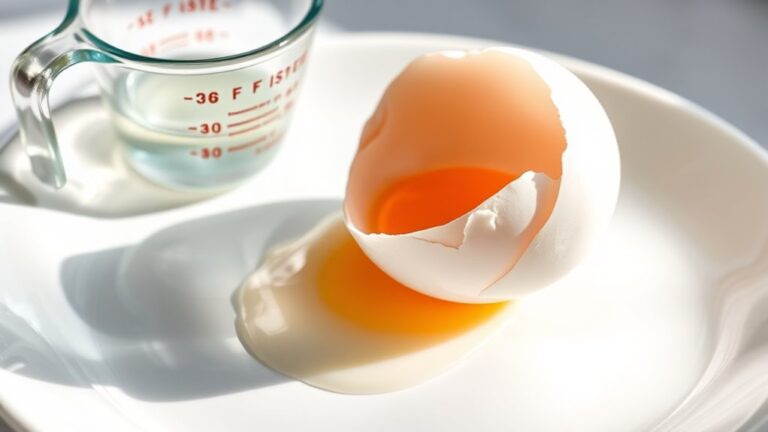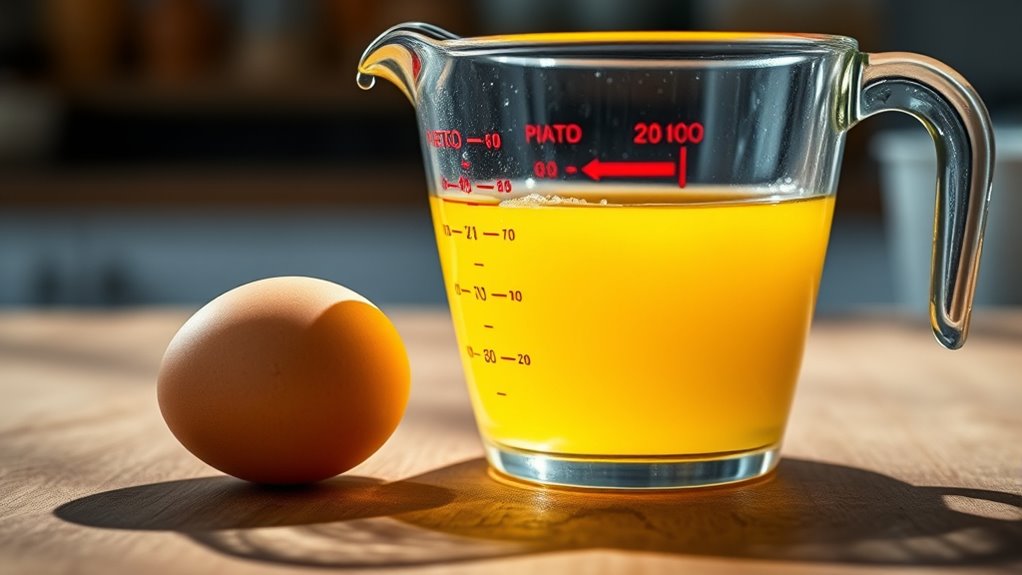
How Much Liquid Egg Equals One Whole Egg
You’ll need about 3 tablespoons of liquid egg to replace one whole egg, but always shake the carton well before measuring to guarantee consistency.
How much liquid egg equals one whole egg can vary, so it’s important to get this right for your recipes. Egg size and product formulation can affect the exact amount, so check the label for specific conversion info.
Using the right volume helps maintain your recipe’s texture and flavor. If you want to avoid common mistakes and get portioning just right, there’s a bit more to know.
Following these guidelines ensures your dishes turn out perfectly every time.
Measure Liquid Egg for One Whole Egg
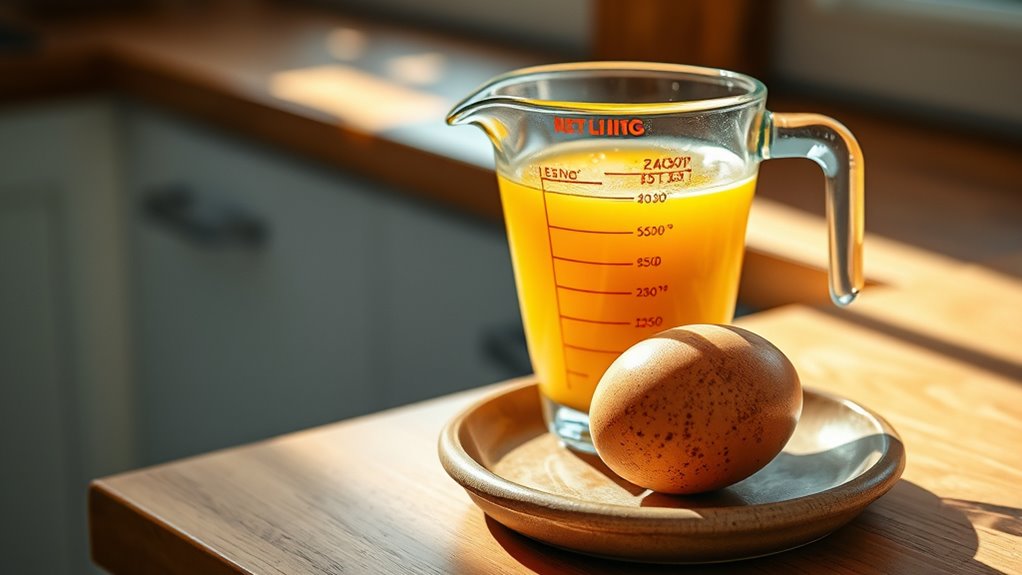
How much liquid egg do you need to substitute for one whole egg? Typically, you’ll use about 3 tablespoons of liquid eggs to replace one large egg. For more accuracy, measure roughly 3 1/4 tablespoons since formulations can vary slightly across brands.
Before measuring, give the carton a good shake to mix the yolks and whites evenly. This ensures your measurement reflects the true consistency of whole eggs. Keep in mind that different liquid egg products might have slightly different serving sizes, so always double-check the label for exact equivalents.
Why Egg Size Matters for Liquid Egg Substitutions
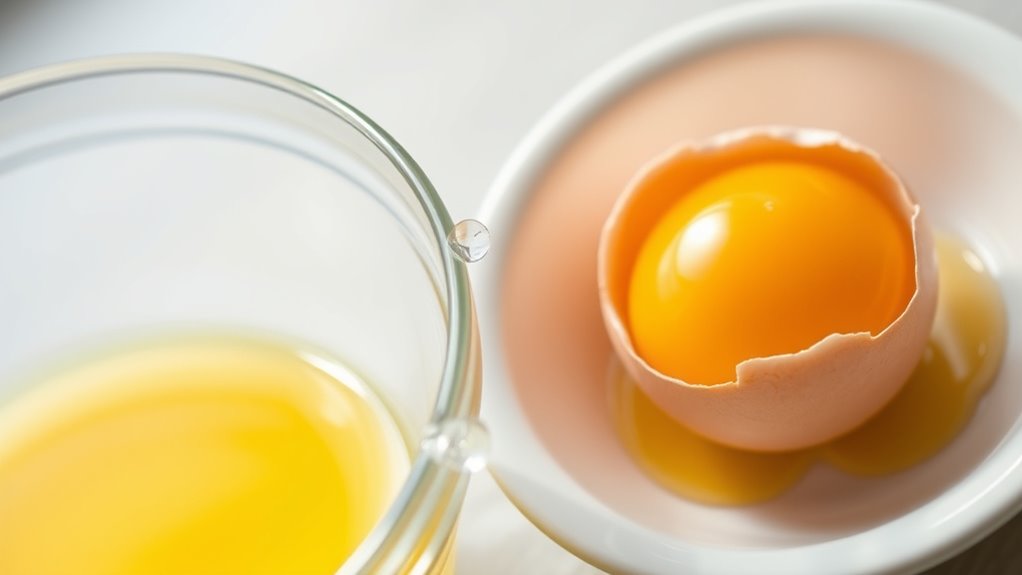
Measuring the right amount of liquid egg for one whole egg is just the start—understanding the size of the egg your recipe calls for makes a big difference. Egg size directly impacts how much liquid egg you use, especially since a large egg contains about 3 tablespoons of liquid.
If your recipe calls for jumbo or small eggs, you’ll need to adapt the volume of liquid egg accordingly. Using liquid egg without considering egg size can throw off moisture levels, texture, and binding in your dish.
For consistent results, match the liquid egg volume to the specific egg size specified in your recipe. This attention to detail ensures your baked goods and other dishes come out perfectly every time.
Understanding Liquid Whole Eggs, Egg Whites, and Yolks
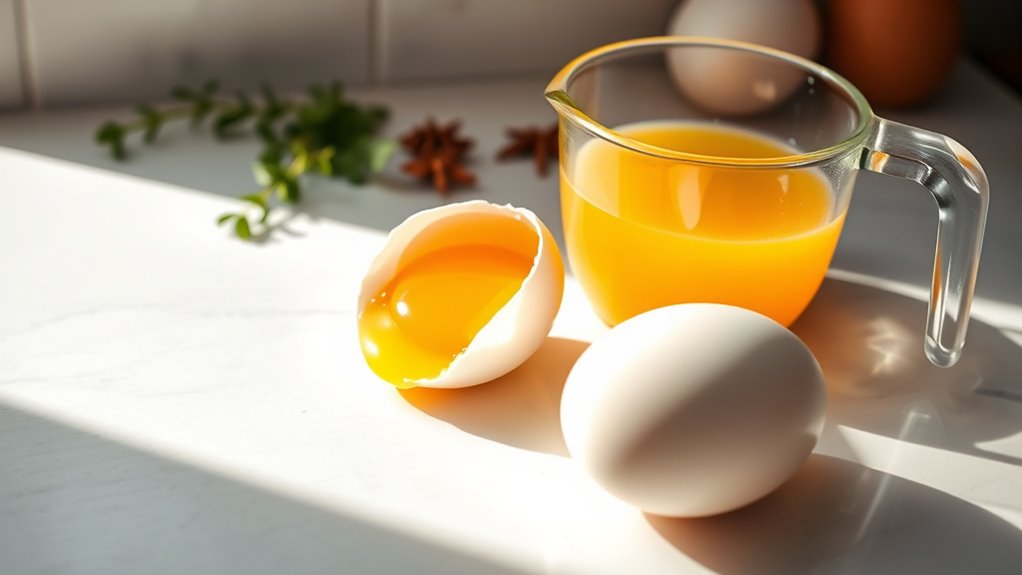
You’ll find liquid eggs come in three main types: whole eggs, egg whites, and yolks.
Egg whites offer a low-calorie, high-protein option, while yolks provide rich flavor and nutrients. Understanding these differences helps you choose the right liquid egg for your recipe.
Liquid Egg Types
Why choose between liquid whole eggs, egg whites, or yolks? Each type serves a different purpose. Liquid whole eggs combine both whites and yolks, giving you the complete nutrition and flavor of a whole egg.
Liquid egg whites come without yolks, perfect if you want less fat or cholesterol. Liquid yolks provide just the richness of the yolk.
Here’s a quick comparison:
| Egg Type | Volume per Large Egg Equivalent |
|---|---|
| Liquid Whole Egg | 3 tablespoons (approx. 1/4 cup) |
| Liquid Egg Whites | About 2 tablespoons |
| Liquid Yolks | About 1 tablespoon |
Always check labels since brands vary. Using liquid eggs saves time while matching whole egg consistency.
Egg White Benefits
Egg whites offer a powerful nutritional punch without the added fat or cholesterol found in yolks. When you choose liquid egg whites, you get a fat-free, cholesterol-free source of high-quality protein, making them ideal for heart-healthy and low-calorie diets.
Since one large egg contains about two-thirds white by volume, liquid egg whites provide substantial protein while keeping calories and fat low. Compared to whole eggs, liquid egg whites allow you to reduce fat and cholesterol intake easily without sacrificing protein content.
Using liquid egg whites alone can help you craft recipes that are lighter but still nutritious. Whether you’re cooking for fitness goals or managing cholesterol, liquid egg whites offer a flexible, healthy alternative to whole eggs, fitting seamlessly into your diet.
Yolks Versus Whole
Although both liquid whole eggs and liquid egg whites come from the same source, they offer different nutritional profiles and uses in cooking. Liquid whole eggs combine yolks and whites, giving you the full nutrition and flavor of a complete egg in a convenient, uniform product. If a recipe calls for one large egg, you’ll usually substitute 1/4 cup of liquid whole eggs.
On the other hand, liquid egg whites contain no yolk and are ideal when you want to reduce fat or cholesterol. If you only need yolks, liquid egg yolk is sold separately, with roughly 1 tablespoon representing one yolk. Understanding these differences helps you pick the right liquid egg form for your dish and guarantees proper nutrition and texture.
How to Read Labels for Liquid Egg Conversions
When you check a liquid egg label, how do you know the right amount to use? Start by looking for statements like “1/4 cup of liquid egg equals 1 egg.” This helps you convert liquid eggs accurately based on egg size.
Some labels also specify how many eggs a carton contains, which is handy for portioning. Don’t forget to check CN labels if you’re cooking for school programs—they provide exact crediting info.
When in doubt, verify online product details to confirm conversions.
| Label Info | What It Means |
|---|---|
| “1/4 cup liquid egg = 1 egg” | Use 1/4 cup for each egg needed |
| Eggs per carton | Helps measure total eggs inside |
| CN Label Credit | School meal program standard |
| Serving size equivalence | Converts liquid to whole eggs |
Using Liquid Eggs in Recipes: Best Practices
Since accurate measurement is key, you should use about 3 tablespoons of liquid eggs to replace one whole egg in your recipes. Before measuring, shake the liquid eggs carton well to guarantee a uniform blend. Because egg sizes vary, relying on liquid eggs removes guesswork, offering consistent results whether you’re baking or scrambling.
If your recipe demands precise egg quantities, check the product’s formulation statement for accurate crediting. Liquid eggs work great for binding and provide uniform texture every time. Using liquid eggs also simplifies adjustments when scaling recipes.
Remember to refrigerate any unused portion and use it within the recommended shelf life to maintain quality. Following these best practices helps you seamlessly incorporate liquid eggs into your cooking routine.
Storing and Handling Liquid Eggs Safely
To keep your liquid eggs fresh and safe, store them in the refrigerator at or below 40°F (4°C). Proper storage is key to preventing spoilage and maintaining quality. Always keep liquid eggs in their original packaging and avoid transferring them to unsealed containers, which can lead to contamination.
Before using, shake the carton well to mix the yolks and whites evenly. Once opened, use the liquid eggs within 3 to 5 days to ensure safety. If you notice any off smell, discoloration, or unusual texture, discard the product immediately.
Common Mistakes When Replacing Shell Eggs With Liquid Eggs
When you measure liquid eggs, using too much or too little can throw off your recipe’s balance, since 1/4 cup usually equals one large egg.
You also need to understand crediting guidelines to guarantee accurate nutritional info and proper portioning. Ignoring these details can lead to inconsistent results and errors in meal programs.
Incorrect Volume Measurement
Although liquid eggs offer convenience, you’ll often run into problems if you don’t measure their volume accurately. Many assume that 1/4 cup of liquid egg equals one whole large egg, but this usually provides only about half to two-thirds of a large egg’s volume.
Using too little liquid egg can leave your recipe lacking moisture and binding, while overestimating it may make the dish overly moist and alter texture. Since liquid egg products vary—some aren’t 100% egg—it’s vital to check the specific product’s information.
Misunderstanding Crediting Guidelines
Even if you’re familiar with liquid egg products, you might overlook critical crediting guidelines that guarantee proper meal compliance. A common mistake is assuming 1/4 cup of liquid eggs equals one whole egg. In reality, for 100% egg products, 1/4 cup only credits as 1/4 of an egg.
If you don’t follow these crediting guidelines, you risk over- or under-crediting, which can lead to non-compliance with school nutrition standards. It’s essential to verify product formulation statements because liquid eggs vary. Assuming they’re equivalent to shell eggs without checking documentation often results in improper portioning.
Always adjust for product-specific crediting details, especially with non-100% egg products, to ensure your meals meet required patterns and avoid common pitfalls when replacing shell eggs with liquid eggs.
Frequently Asked Questions
What Does Dr. Gundry Say About Eggs?
Dr. Gundry says you should choose organic, pasture-raised eggs for better nutrients and avoid antibiotics.
He recommends eating eggs in moderation, especially if you have heart concerns, and balancing them with other nutrient-rich foods for ideal health.
How Much Just Egg Liquid Equals One Egg?
Think of just egg liquid as a magic potion—use about 3 tablespoons or 1/4 cup to replace one whole egg.
Always check the label, so you’re not flying blind in your recipe.
How Much Liquid to Replace One Egg?
You’ll need about 3 tablespoons or 1/4 cup of liquid egg to replace one whole egg. Just shake the carton well before measuring, and double-check the label since concentrations can vary slightly between brands.
How Much Liquid Measure Is One Egg?
One large egg measures about 3 tablespoons of liquid.
Conclusion
You might worry that using liquid eggs won’t give you the same results as whole eggs, but if you measure carefully and choose the right type—whole, whites, or yolks—you’ll get consistent, reliable outcomes every time.
Just remember, one whole egg equals about 3 tablespoons of liquid egg. With proper handling and storage, liquid eggs can save you time without sacrificing quality.
Give it a try, and you’ll see how easy it is to substitute liquid eggs for whole eggs in your recipes. Understanding how much liquid egg equals one whole egg ensures your cooking and baking turn out perfect every time.