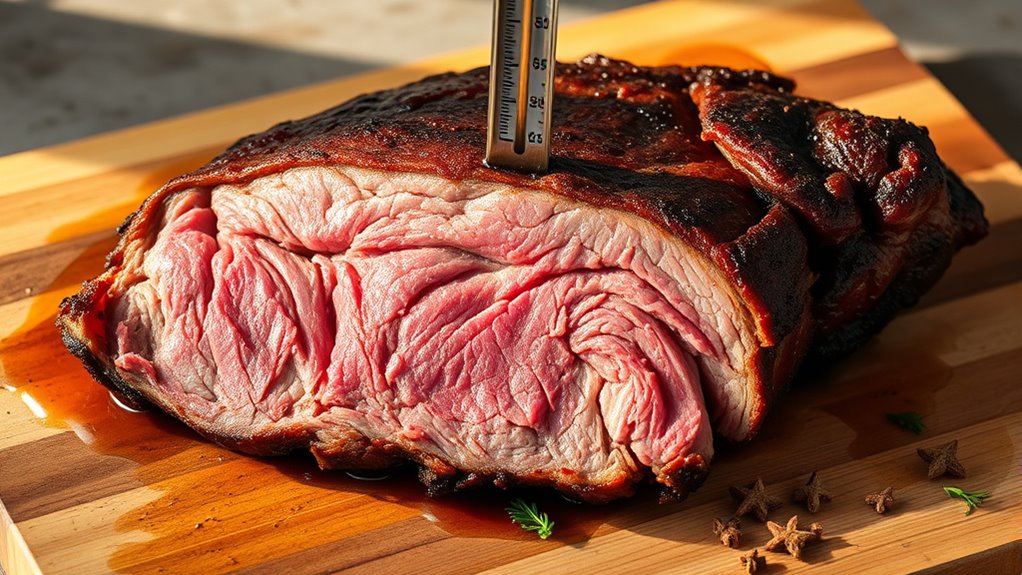
What Should the Internal Temp of Beef Brisket Be for Perfect Cooking?
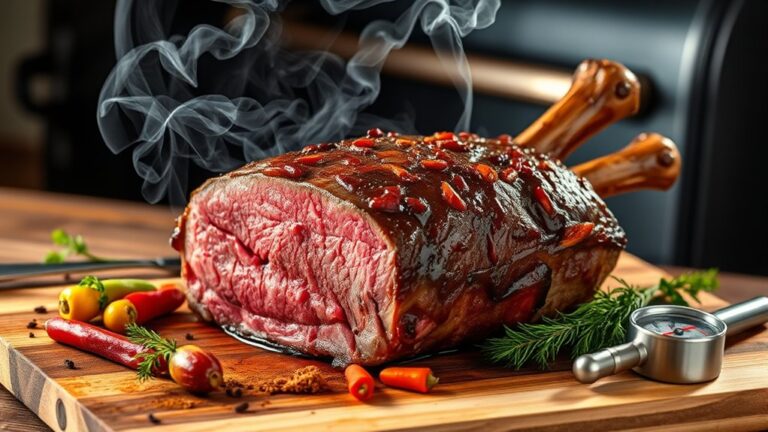
You should cook your beef brisket to an internal temperature between 195°F and 205°F for perfect tenderness. This range allows collagen to break down, making the meat melt-in-your-mouth soft.
Use a reliable digital thermometer inserted into the thickest part, avoiding fat or bone.
Remember, temperature alone isn’t enough—look for a tender feel and let the brisket rest for at least 30 minutes.
Keep going, and you’ll discover tips to handle stalls, size differences, and avoid common pitfalls for a flawless cook.
How To Tell When Your Brisket Is Done: Key Temperatures And Signs
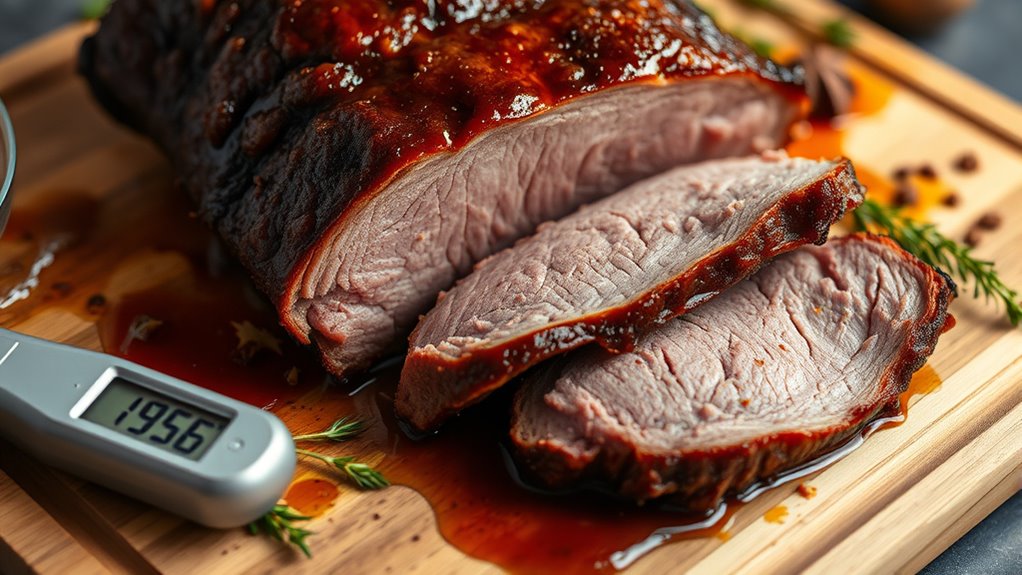
Although it can be tempting to rely solely on time, you’ll know your brisket is done when its internal temperature reaches between 195°F and 205°F and a probe slides through the meat with little resistance, indicating tender, fully cooked meat.
Using a probe thermometer helps you track the internal temperature accurately, which is a key sign your brisket is ready. You’ll notice the probe should slide in as easily as it does through soft butter — that’s the tenderness you want.
Don’t be fooled by the stall around 165°F; your brisket isn’t done until it hits the target temperature and tenderness. Once done, let your brisket rest for at least 30 minutes to let the juices redistribute, ensuring consistent tenderness throughout.
Ideal Internal Temperature Range For Perfect Brisket Tenderness
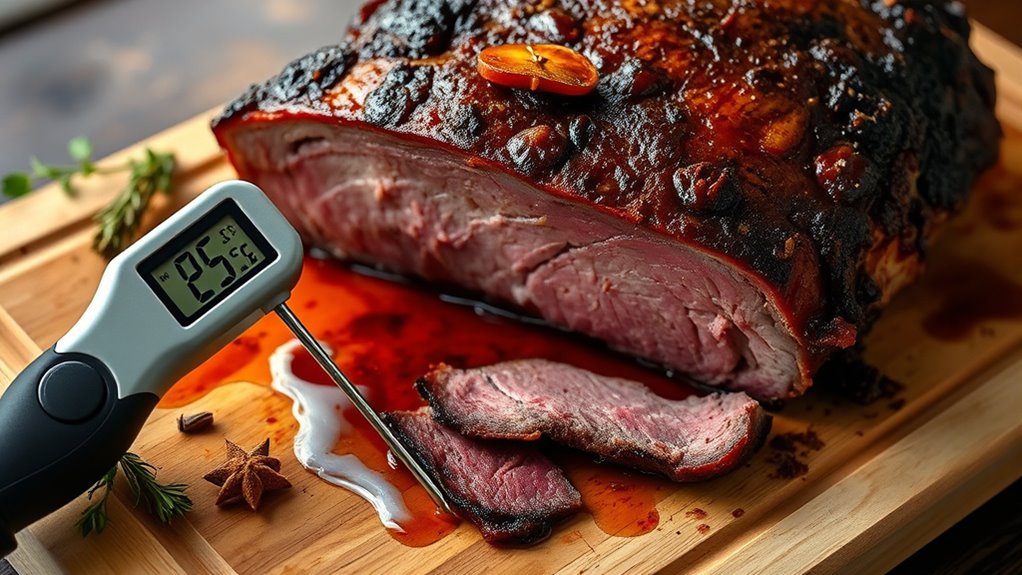
When you aim for perfect brisket tenderness, you need to target an internal temperature between 195°F and 205°F. This range guarantees proper collagen breakdown, transforming the tough connective tissue into juicy, tender meat. A fully cooked brisket hits its ideal temperature around 203°F, where tenderness peaks.
You’ll know it’s ready when the probe slides easily into the thickest part. Temperatures below 195°F risk toughness, while going over 210°F can dry out your brisket. Use a reliable meat thermometer to monitor this essential stage.
- Ideal internal temperature ensures maximum collagen breakdown
- Probe slides easily signals perfect tenderness
- Avoid under 195°F to prevent toughness
- Don’t exceed 205°F to maintain juiciness
Hitting the right internal temperature guarantees a perfectly tender brisket every time.
Adjusting Temperature Targets For Different Brisket Sizes And Grades
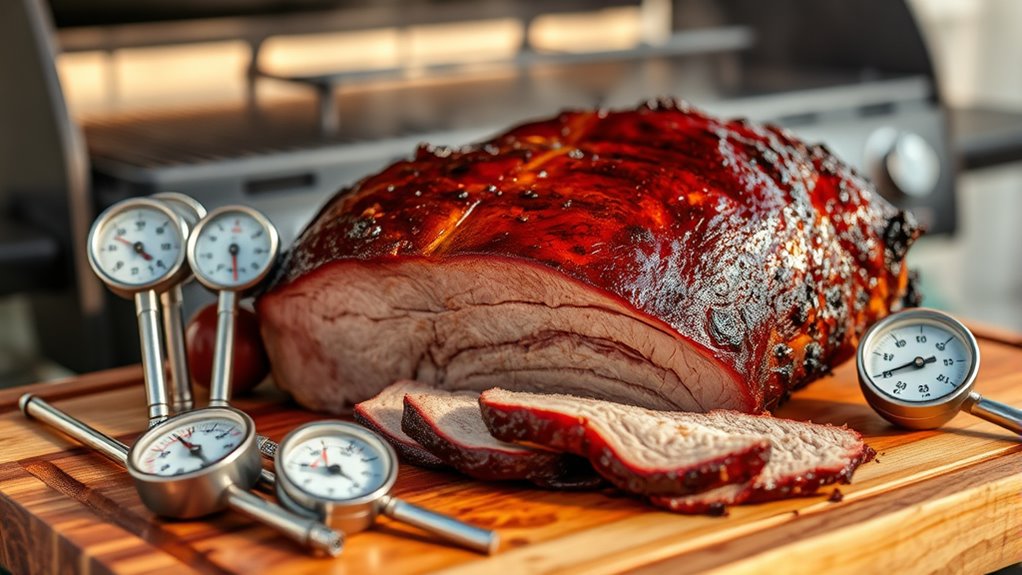
When cooking brisket, you’ll want to adjust your target temperature based on its size and grade to get the best results. Larger cuts usually need higher internal temps, while prime grades often become tender at slightly lower temperatures.
Understanding these differences helps you prevent dryness and ensures your brisket turns out perfectly every time.
Brisket Size Impact
Since brisket size and grade directly affect cooking time and tenderness, you’ll need to adjust your internal temperature targets accordingly. The brisket weight plays a key role in how long you cook it and the internal temperature it should reach for ideal tenderness.
Larger cuts, over 12 pounds, usually require longer cooking times and an internal temperature near 200-205°F. Smaller briskets under 8 pounds cook faster and often finish around 195-200°F.
- Larger briskets demand patience for tender results
- Smaller briskets hit target temps quicker, around 6-8 hours
- Adjust internal temperature based on brisket size for consistent doneness
- Brisket grade influences how temperature affects tenderness
Grade Influences Cooking
Brisket size isn’t the only factor that changes how you approach cooking temperatures; the grade of your brisket plays a significant role as well. Prime grade briskets, with their higher marbling and fat content, reach ideal tenderness between 195°F and 205°F. Choice grade cuts, having less marbling, usually need a slightly higher internal temperature—around 200°F to 210°F—to achieve the same doneness.
Lower grades or select briskets require cooking to at least 205°F to ensure proper collagen breakdown and tenderness. By adjusting your target internal temperature based on the brisket’s grade, you maximize collagen breakdown and tenderness, ensuring consistent doneness and flavor. This tailored approach helps you get the best results regardless of the brisket’s size or quality grade.
Temperature Adjustments Needed
Although size and grade influence cooking times, you should focus on internal temperature and tenderness to adjust your approach. Size adjustments mainly affect cook time, but the ideal internal temperature range remains consistent. Marbling also plays a key role—prime briskets with more fat often reach tenderness faster at slightly lower temps.
Lower grades need more heat and time to break down connective tissue. Larger briskets require extended resting to distribute juices evenly. Prime grade briskets typically finish between 195-200°F for excellent tenderness.
Select cuts benefit from cooking closer to 205°F due to less marbling. Test tenderness, not just rely on size, to determine doneness.
How To Use A Thermometer For Accurate Brisket Cooking
To get accurate readings, always insert your thermometer into the thickest part of the brisket, steering clear of fat and bones. Choose a reliable digital thermometer, like one with a probe and cord, so you can monitor the temperature continuously throughout the cook.
Don’t forget to calibrate your device regularly and keep the probe in during resting to catch the perfect serving temperature.
Thermometer Placement Tips
When you want an accurate internal temperature, insert your thermometer probe into the thickest part of the brisket’s flat muscle, steering clear of fat or the point. Proper thermometer placement is key for precise probe positioning and an accurate reading. Make sure the tip reaches the meat core, avoiding bone or the pan.
Before cooking, always calibrate your thermometer to ensure reliability.
- Insert the probe at a slight angle to reach the thickest part of the meat core.
- Avoid fat, bone, or the point to prevent false readings.
- Use a leave-in or digital instant-read thermometer for continuous monitoring.
- Calibrate your thermometer in boiling or ice water before use for accurate internal temperature tracking.
Monitoring Internal Temperature
Monitoring your brisket’s internal temperature closely guarantees you cook it to perfection every time. Use a reliable digital meat thermometer and insert the probe into the thickest part of the brisket, avoiding fat or bone, for accurate readings. Check the internal temperature regularly, especially as it nears 195°F to 205°F, to prevent overcooking or undercooking.
Proper probe placement is key to gauging doneness accurately. For even results, consider using a multi-channel thermometer or dual probes to monitor both the flat and point muscles simultaneously. Once the internal temperature hits around 200°F to 205°F and the meat feels tender when probed, remove your brisket from heat.
This method guarantees your brisket is perfectly cooked, juicy, and tender every time.
Choosing Reliable Thermometers
Although selecting the right thermometer might seem straightforward, choosing a reliable and accurate device is essential for perfectly cooked brisket. You want a thermometer that provides precise internal temperature readings to avoid under or overcooking.
An instant-read thermometer like the Thermapen ONE offers quick accuracy, while a dual-probe option lets you monitor both meat and pit temperatures simultaneously. Don’t forget to perform regular probe calibration to maintain accuracy, especially before long cooks.
- Use an instant-read thermometer for fast, accurate readings
- Insert the probe into the thickest part, avoiding bone and fat
- Calibrate your thermometer regularly for consistent accuracy
- Consider a dual-probe thermometer to track brisket and smoker temps
Choosing the right tool ensures your brisket hits that perfect tenderness every time.
What’s The Brisket Stall And How Does It Affect Cooking?
If you’ve ever noticed your brisket’s temperature stalling between 150°F and 170°F, you’re experiencing the brisket stall—a natural pause caused by moisture evaporating from the meat’s surface. This evaporative cooling effect creates a plateau in the internal temperature, slowing down the cooking process for several hours.
During this time, heat energy is used to evaporate moisture rather than raising the brisket’s temperature. To overcome the stall, many pitmasters use wrapping techniques with butcher paper or foil, which traps moisture and reduces evaporative cooling, allowing the internal temperature to rise faster.
The stall ends once collagen in the brisket begins to break down, leading to a sudden jump in temperature past 170°F. Understanding the brisket stall helps you better manage cooking times and achieve tender results.
Low-And-Slow Vs. Hot-And-Fast: Choosing The Right Temperature Strategy
When you choose how to cook your brisket, deciding between low-and-slow and hot-and-fast methods shapes the final texture and flavor. Low-and-slow cooking at 225°F to 250°F slowly breaks down collagen over 10-18 hours, maximizing tenderness. Hot-and-fast cooks at 300°F to 350°F, speeding up the process to 4-6 hours while still achieving great flavor and bark.
Choosing low-and-slow or hot-and-fast cooking impacts brisket’s tenderness, flavor, and bark development.
Both rely on careful temperature control to break down collagen between 170°F and 203°F.
Consider these factors when choosing your temperature strategy:
- Brisket size influences cooking time and method.
- Low-and-slow offers consistent tenderness.
- Hot-and-fast delivers a pronounced bark quickly.
- Monitoring temperature prevents drying out.
Choose the method that fits your time and desired brisket tenderness best.
Signs Your Brisket Is Ready Without Relying On Temperature Alone
Even though internal temperature provides a useful guideline, you can’t rely on it alone to judge when your brisket is ready. While a range of 200-205°F often signals sufficient collagen breakdown, the true test lies in checking tenderness.
Perform a tenderness test by inserting a probe into the thickest part—if it slides in and out easily, your brisket is probe tender and likely done. Look for visual cues like glossy bark and juice runoff, which complement internal temperature readings.
Keep in mind, even at the right temp, brisket can remain tough without a proper rest period. Trust your senses and tenderness tests alongside temperature to guarantee your brisket reaches ideal softness and flavor every time.
How Resting Time Improves Brisket Juiciness And Tenderness
Allowing your brisket to rest for at least 30 minutes lets the juices redistribute evenly, making every slice juicier and more flavorful. During resting, the internal temperature stabilizes around 160-165°F, enabling collagen to break down further. This process enhances tenderness and helps retain moisture, preventing excessive juice loss when you slice.
Proper resting ensures your brisket stays moist and tender.
Keep these points in mind during resting:
- Resting time allows collagen to soften, improving tenderness
- Stabilized internal temperature reduces moisture escape
- Juices redistribute, boosting overall juiciness
- Wrapping or cooling during resting retains heat and moisture longer
Common Temperature Mistakes That Can Ruin Your Brisket
Because maintaining the right internal temperature is essential, common mistakes like overcooking past 210°F or stopping too early around 190°F can ruin your brisket’s texture and tenderness. Overcooking dries out the meat, while undercooking leaves collagen unbroken, making it tough. Ignoring the stall, where the internal temp plateaus near 165°F, often leads you to leave the brisket in too long, causing overcooking on the outside.
Relying on time instead of a reliable thermometer increases risk since brisket size and smoker conditions vary. Also, using an inaccurate thermometer can mislead you about doneness, resulting in disappointing results. To avoid these pitfalls, monitor the internal temp carefully, understand the stall, and trust your thermometer to cook your brisket perfectly every time.
Frequently Asked Questions
Is Brisket Done at 190 or 200?
Brisket isn’t typically done at 190°F because it might still be tough. You want to aim for around 200°F to break down collagen fully, ensuring that tender, juicy, melt-in-your-mouth texture you’re after.
What Is the Perfect Temperature for Brisket?
You want your brisket to hit around 200°F, where collagen melts like morning frost under sunlight, turning the meat tender and juicy.
Trust your thermometer and watch the probe glide in like warm butter for perfection.
Is Brisket Better at 195 or 205?
You’ll find brisket better at 195°F if you want firmer, sliceable meat, but if you prefer it super tender and falling apart, 205°F is your go-to.
It depends on the texture you crave.
Is Brisket Overcooked at 210 Degrees?
You aren’t necessarily overcooked at 210°F, but if you hold brisket there too long, it can dry out.
Aim for 200-205°F, then rest it well to keep it juicy and tender.
Conclusion
Mastering brisket is like tuning a fine instrument—it takes patience and precision. Aim for an internal temp between 195°F and 205°F for that perfect, tender bite. Don’t rush; use your thermometer wisely and watch for signs beyond numbers.
Remember, resting your brisket seals in juiciness like a secret ingredient. Avoid common temp mistakes, and you’ll turn out a brisket that sings with flavor every time. Keep calm, cook slow, and enjoy the perfect internal temp of beef brisket for the best cooking results!